
Filipino Classics & Perya Games Hub
Return to the main pillar overview for perya game online.
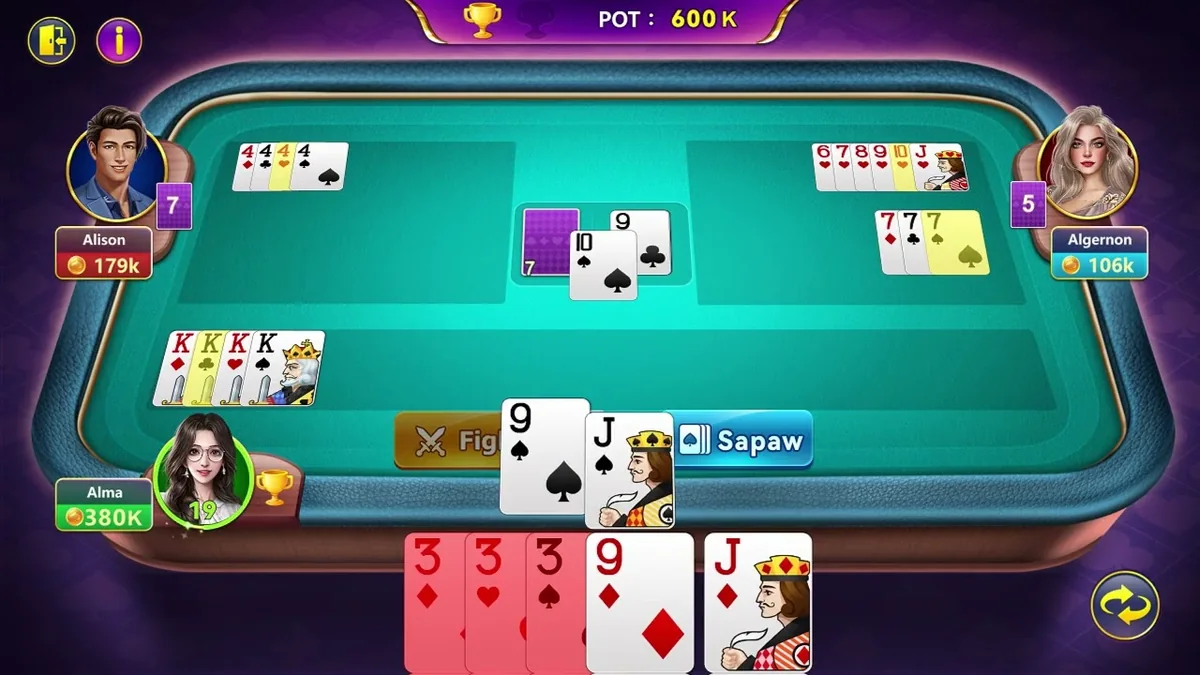
Sitting down at online Tongits real money GCash tables feels instantly familiar if you have played around a barangay table, yet digital lobbies enforce strict timers and automated multipliers that punish careless mistakes. Unlike casual family games where players negotiate rules mid-round, online rooms calculate every point, secret meld bonus, and burned penalty automatically in Philippine Pesos (₱).
This beginner-friendly guide breaks down the 12/13 card deal, valid melds and *sapaw* lay-offs, when to call Tongits versus Fight or Draw, and how 2x/4x/8x table multipliers affect a ₱300 GCash reserve. You will also learn how table rake works and why seat selection matters more than chasing lucky draws.
| Rule Component | Official Specification | Point / Payout Effect | Practical Table Tip |
|---|---|---|---|
| Opening Deal | Dealer gets 13 cards; 2 opponents get 12 each | 15 cards remain in center stock pile | Dealer acts first by discarding 1 card without drawing |
| Deadwood Card Values | Ace = 1 pt; 2–10 = face value; J, Q, K = 10 pts | Lower total deadwood wins Draw/Fight showdowns | Dump unmelded J, Q, K cards early unless pairing |
| Valid Melds (Bahay) | 3–4 of a kind OR 3+ sequential same-suit cards | Removes cards from deadwood count | Expose at least 1 meld early to avoid Sunog penalty |
| Fight / Challenge Call | Triggered before drawing when >=1 meld is exposed | Lowest deadwood collects base stake + bonuses | Only call Fight with <=12 points against slow opponents |
| Multiplier Escalation | Tongits win, Secret Meld, Ace, or Burned (Sunog) | Multiplies base loss by 2x, 4x, or up to 8x | Bring 50x base stake to survive stacked multipliers |
Follow the exact turn order enforced by digital Philippine Tongits tables from deal to payout.
Having 13 cards first gives the dealer an immediate information edge on turn one. They can inspect whether they hold a natural *bahay* (meld), drop a high-point face card safely, or keep a tight two-card connector before anyone else draws. Meanwhile, the remaining 15-card stock means a full hand usually ends within five to eight turns per player.
That short 15-card stock is why speed matters so much in digital rooms. If you hold onto unmelded Kings and Queens hoping to catch a miracle straight on the final turn, the deck will run dry and punish your deadwood score. Readers comparing other local classics can also check our Filipino classics and perya hub to see how Tongits skill edges contrast with pure-chance dice games.
Beginners frequently forget that *sapaw* works in both directions on a suited run and onto opponents' melds. If the player to your left lays down 6-7-8 of Spades, and you hold the 5 of Spades or 9 of Spades, dropping that card onto their meld shrinks your hand without waiting for another pair.
Equally important, laying off onto an opponent's meld prevents them from calling Fight on their very next turn! Most online Tongits lobbies lock the Fight button for one full turn cycle whenever someone *sapaws* that player's exposed *bahay*. Learning when to hold a *sapaw* card as defensive insurance separates steady PHP winners from impulsive meld dumpers.
Calling **Tongits** is the cleanest victory because you empty your hand completely—either via your final meld/sapaw or by discarding your last card—and collect full base payouts plus Tongits bonuses from both opponents. Calling **Fight**, by contrast, is a calculated challenge available only at the start of your turn before drawing, provided you already exposed at least one meld and nobody *sapawed* you since your last turn.
If an opponent suspects your hand is actually weaker than theirs, they can Accept (Challenge) your Fight, raising the stakes; if they Fold, they concede the base payout to avoid a heavier showdown loss. When all three seats play cautiously until the stock hits zero, the round resolves as a **Draw**, where the lowest deadwood point total wins—with Ace ties or identical point totals broken by the last card drawn or suit rules depending on room settings.
If a round ends while you have zero exposed melds on the table, you are declared *Sunog* (burned). Even if you secretly hold a low point count like 8 points in hand, being burned triggers an automatic loss against the winner plus a 2x penalty multiplier.
Watch the remaining stock counter in the corner of the screen carefully. Once the stock drops to four or five cards, lay down at least one safe three-card meld immediately so you cannot be caught burned.
Suppose you deposit ₱300 via GCash and sit at a ₱10 base-point Tongits table. Beginners often assume ₱300 equals 30 safe hands, forgetting how stacked multipliers work. Suppose Opponent A holds a secret meld (hidden four-of-a-kind or double meld bonus), holds two Aces in their meld, and declares Tongits while Opponent B was burned (*Sunog*).
Here is how a single hand escalates from ₱10: Base loss = ₱10, Tongits victory doubles to 2x (₱20), a Secret Meld or Ace bonus doubles again to 4x (₱40), and if you were burned or folded into a raised challenge, the combined hit reaches 8x (₱80) in a single three-minute deal! Holding at least 30x to 50x the table base stake—meaning ₱300 to ₱500 for a ₱10 room—keeps normal multiplier swings from busting your seat prematurely. For smooth payout tracking once you finish a session, check our Tongits GCash withdrawal walkthrough.
Unlike Perya dice games where the house stands opposite every bettor, Tongits pits three human players against one another. Because the platform does not hold cards against you, it deducts a transparent fee from each settled pot. Checking whether a lobby charges 3% versus 5% rake makes a noticeable difference over 50 hands.
To fund your seat cleanly, use a verified personal GCash account through the platform's encrypted cashier rather than informal messenger clubs. You can compare deposit minimums and wallet limits in our GCash and Maya payments hub or verify platform authorization directly on pagcor.ph. If you want to compare another skill-heavy Filipino card room, explore our Pusoy online Philippines handbook.
Because Tongits depends heavily on what the seat to your left discards, two cooperating players at the same three-seat table can feed melds to each other while starving the third seat. Licensed public lobbies defend against this by assigning seats automatically from a wide player pool and monitoring abnormal chip-dumping histories.
If you notice a seat repeatedly discarding obvious connecting cards directly into one player's exposed runs, leave the table immediately after that hand finishes and report the table ID to support. You can review full platform security standards on our PAGCOR safety and KYC hub or test mobile stability via our Jiliwin mobile app guide.
Newcomers lose the most PHP in Tongits during the first two turns by hoarding high face cards—Kings, Queens, and Jacks—just because they look strong in poker. In Tongits, an unmelded King costs 10 deadwood points in a Fight showdown, whereas an Ace costs only 1 point. Unless two face cards already pair up or form a suited Q-K connector, shed high deadwood early.
Watch what the opponent to your right discards as well. If they drop a 9 of Clubs, cards near 8-9-10 of Clubs become safer discards for you, reducing the chance you accidentally feed someone a *sapaw* or Tongits finisher. Pair smart discard reading with a firm 45-minute session cap so mental fatigue never leads to careless Fight calls.
Real-money Tongits lobbies on Philippine-regulated platforms are strictly limited to players aged 21 years old and above. Before depositing PHP via GCash, lock in a realistic session budget—such as ₱200 to ₱500 from discretionary leisure money—and step away whenever your preset win target or loss limit is reached.
Always verify legitimate gaming platforms on pagcor.ph, where 24-hour self-exclusion tools can be activated across all access points including the mobile app. Free, confidential support is available from the National Council on Problem Gambling Philippines, Gamblers Anonymous Philippines, and the PAGCOR Responsible Gaming Helpline.
Playing online Tongits real money GCash rooms successfully blends traditional barangay card sense with sharp bankroll discipline. By respecting the 12/13 opening deal, shedding high 10-point face cards early, avoiding *Sunog* burned penalties, and bringing 30x–50x table reserves for 2x/4x/8x multipliers, beginners give themselves the cleanest edge possible at every three-seat room.
Ready to explore verified card lobbies within your 21+ pre-set limits? Platform members can Invite your friends to register and play and get a chance to earn bonuses of up to ₱50,000.00. You can also Get a chance to win up to ₱100,000.00 plus unlock exclusive Mystery Chests while keeping your sessions fun and controlled.
Yes, legitimate platforms verified under PAGCOR regulations offer three-player Tongits lobbies with direct GCash and Maya withdrawals once your identity is verified. Always confirm the operator directly on pagcor.ph and avoid downloading random APK files shared by unverified Facebook pages.
Online Tongits uses a standard 52-card deck for three players: the dealer receives 13 cards, and each of the two remaining players receives 12 cards. The leftover 15 cards form the central draw stock pile.
Aces count as 1 point, numbered cards 2 through 10 count at their face value, and Jacks, Queens, and Kings count as 10 points each. Only unmelded cards remaining in your hand (deadwood) count toward your point total, and the lowest score wins.
Multipliers stack when special win or penalty conditions occur in the same hand. Winning directly by Tongits, holding hidden melds or bonus Aces, or catching an opponent burned (Sunog) with zero exposed melds doubles the base payout, stacking up to 4x or 8x depending on table rules.
You can only call Fight before drawing a card, after you have laid down at least one exposed meld, and only if no opponent laid off (sapaw) a card onto your melds since your previous turn. If someone sapawed you, the system locks Fight for one round.